
Mobile App Development Strategies: Create Scalable & Successful Apps
The majority of apps do not fail due to poor code. This is because there was no actual plan behind them. Statista estimates more than 8.9 million apps in major app stores as of 2024 – and the overwhelming majority of them have never reached 1,000 downloads. The ones that do? It began with a well-defined, data-driven mobile app development strategy, even before a line of code was written.
This guide will be the dissection of how to actually construct that strategy, not theoretically, but in a manner that is practical and applicable to the real world, with real deadlines and real business objectives.
What Will Mobile App Development Strategies be in 2026?
In its most basic definition, a mobile application development strategy is the entire plan that will take your app through ideas to launch and more. It discusses your target users, the platform you are going to be based on, your tech stack, your timeline, your budget and how you are going to measure success.
Do you want to know what exactly is mobile app development? -it is the entire process of creating, developing, testing and implementing a software that is used to run on mobile devices. That is why a good mobile app strategy is what helps not to make that process chaotic. This is one of the reasons why the veteran teams such as Hefastus give much attention to strategy before typing a single line of the code.
In 2026, the stakes are higher. Users are demanding quick load times, user-clean interfaces and offline apps. Businesses expect ROI. Investors want scalability. Devoid of a clear direction even technically correct apps fail in target.
A 2024 report by Grand View Research suggests that the mobile application market in the world will be worth 614 billion dollars by 2030 with a CAGR of 14.3 percent. It is real growth – and only companies that have a definite mobile app approach are actually reaping the benefits.
Why Is Mobile App Development Strategy Important?
The bitter side of it is that plunging into development without a plan is one of the most costly errors that a company can commit. Development teams find themselves recreating features, missing deadlines and exceeding budget not because they are bad developers, but simply because no one specified what the right target was at the very beginning.
The proper mobile app development strategy assists you in:
- Minimize the possibility of creating features not utilized.
- Have definite schedules and funds to spend and not a penny on development.
- Get your development team, marketing team and stakeholders to work with one vision.
- Select the appropriate platform iOS, Android, or cross-platform depending on your real audience statistics.
- Think big to make sure that your app does not collapse with growth.
In a 2023 study, IBM determined that more than 60 percent of software projects fail because of poor planning. Strategy is not an option, it is the distinction between releasing a product that people can use and burning the development budget on a product that will not stick.
Core Elements of an Effective Mobile App Development Strategy
As Hefastus Solution argues, any successful mobile app strategy is based on a collection of fundamental components. These are not the steps, but the pillars under which the whole development process will be based. Any of them should not be ignored since it is likely to cause delays, increased costs, or products that do not bring actual business benefit.
- Clear Business Goals
You must answer: what is this app about to do to the business? Before any work on the design or the development begins. Drive revenue? Reduce support costs? Retain more customers? Everything is based on your goals, whether it is the features you develop, the measures you monitor, or the age of success you gauge.
- User Research & Personas
You are not your user. It is a sentence that is worth repeating. Actual user research – surveys, interviews, reviews of competitor apps provides you with the information to create something that people really desire. Without it, you’re guessing.
- Platform Decision
iOS or Android? Native or cross-platform? This decision will have an impact on your development schedule, price, and user experience. iOS has approximately 57 percent of the smartphone market in the US as of 2024 (Statista) in case your audience is in the US – it’s a fact to keep in mind when deciding what platform to choose.
- Tech Stack Selection
Depending on your type of app, team competencies, and performance needs, the appropriate app development software and tech stack will be used. React Native, Flutter, Swift, Kotlin – all trade-offs. This should not be the middle of the build, but a process that is defined in your mobile app strategy.
- MVP Scope Definition
Scope creep is one of the largest pitfalls in the development of apps. A clear Minimum Viable Product, the bare minimum version of your app that provides actual value to users should be described in your strategy. Build that first. Learn from it. Then expand.
- Budget & Timeline Planning
An app development plan is not only a realistic plan regarding development hours. It consists of design, QA testing, fees of app stores, marketing, and post-launch maintenance. Apps that exceed the budget nearly always exceed the budget because these costs were not taken into consideration at the beginning.
Mobile App Strategy Roadmap
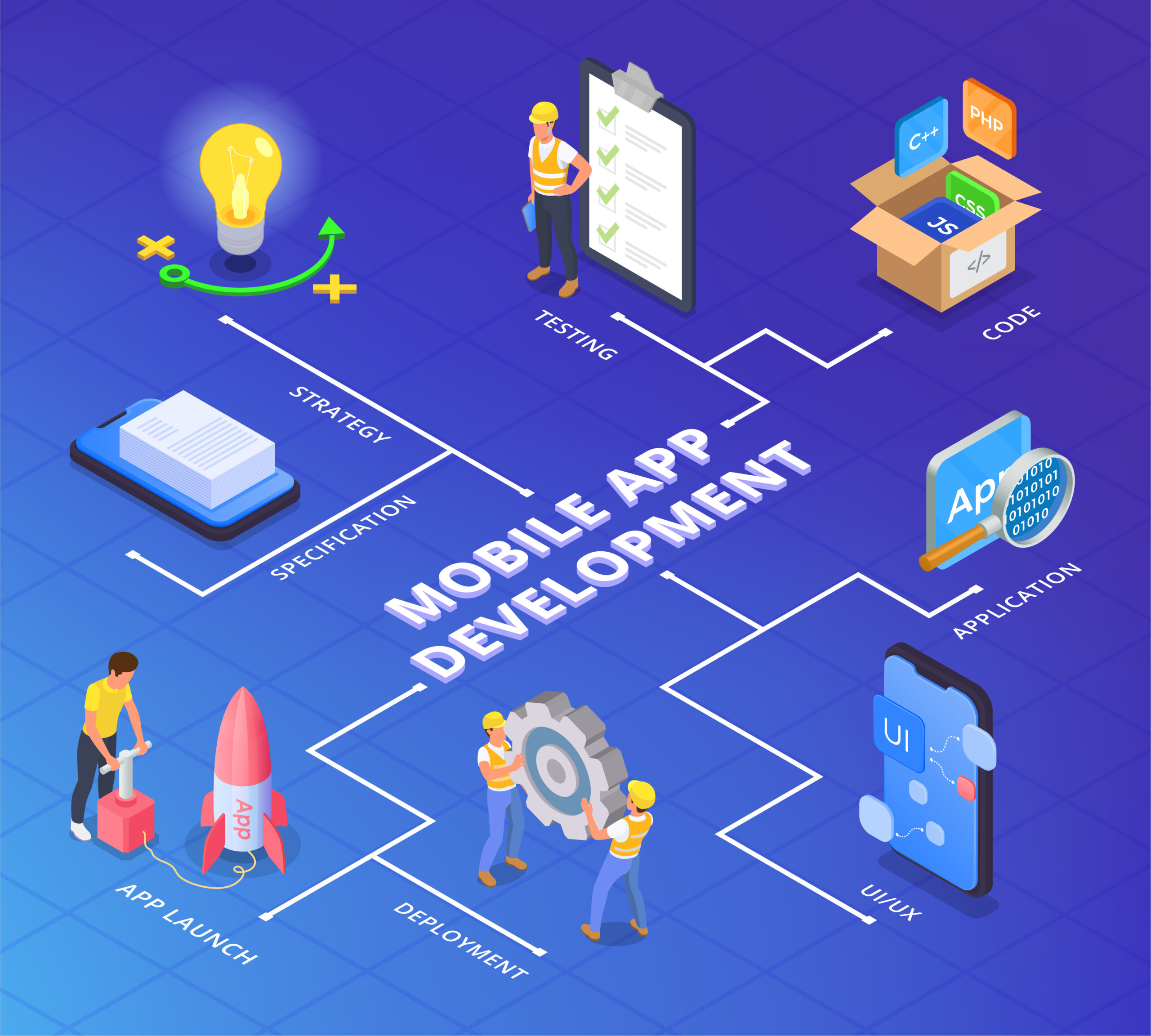
Mobile app strategy roadmap is a plan, which will take your app to the next level. It aids in making teams stay on track, coordinate schedules, and prevent confusion in the course of development. Although these phases differ in different timelines, most successful projects have the following major steps:
Phase 1 – Discovery (Weeks 1-3 ):
Set business objectives, find target users, and competitor research, as well as select the appropriate platform. This makes the app address a practical issue.
Phase 2 – Planning (Weeks 4-5):
Decide on the scope of MVP, choose the technology stack, team roles, and schedules and budgets. This forms a transparent technical and project base.
Phase 3 – Design (Weeks 6-9):
Design wire frames and prototypes to envision the app. UI / UX design is polished so as to create an easy and usable interface.
Phase 4 – Development (Weeks 10-20):
The app is developed in stages in bursts by developers. It is a continuous addition, review and improvement.
Phase 5 – QA & Testing (Weeks 21-23):
The application is tested on bugs, performance, security and compatibility with various devices.
Phase 6 – Launch (Week 24):
The application is uploaded to app stores, and it is released to the users. Visibility is assisted by marketing and launch preparation.
Phase 7 – Post-Launch (Ongoing):
Track the performance, gather user feedback and publish updates to enhance functionality and user satisfaction.
This roadmap is structured yet precise schedules will be determined based on the complexity of the app and the size of the team.
Types of Mobile App Development Strategies
All apps do not require the same strategy. The appropriate mobile development plan would be based on your performance needs, audience, and budget. The following are the key alternatives that businesses are today relying on:
Native App Development
Develop iOS and Android apps individually with platform-specific languages – Swift on iOS, Kotlin on Android. The most expensive and time-consuming but highest performance and user experience. Ideal in application scenarios in which the performance and integration of devices is critical, such as in fintech or healthcare.
Cross-Platform Development
Write a single application, run on iOS and Android with frameworks such as React Native or Flutter. Leaner and quicker to market. There are a few trade-offs in performance, but in most business applications, the difference is not very high.
Progressive Web App (PWA)
A native-like web-based application. No submission to the app store. Reduced price, speed of deployment. Best with high-content apps or companies that are investigating a new market and do not want to invest in a full-fledged native app yet.
Hybrid App Development
Hybrid apps use a core based on Web technology and a native wrap such that it can be executed in a browser and as a native app. Frameworks such as Ionic make it possible. The compromising factor is that hybrid apps might be a little slower than native ones – however, in most applications, they suffice, particularly in an internal enterprise application. This trade-off must be considered by your mobile development strategy before you can commit yourself to a course.
Mobile Application Development Plan vs Mobile App Strategy
These two terms are used interchangeably although they are not synonymous.
The top level strategy is a mobile app strategy: the why, the who, the what and the how. It provides business response and provides direction to the whole project.
The working document is a mobile application development plan: sprint schedules and developer assignment, milestones dates and deliverable lists. It provides responses to execution queries and provides day to day motion of the team.
You need both. The first one is the strategy which is what directly informs the app development plan. It is like writing instructions without knowing where you are going to but attempting to construct a development plan without having a strategy.
Imagine it in the following way: the mobile application development plan is what you give up to the engineering lead; the strategy is what you give up to the CEO. One of them alone renders your project unfocused or unimplementable.
Real World Mobile App Development Strategy Example
Case Study: Fitness Startup Grows to 500K Users in 18 Months.
A startup company in the US had a small budget and a huge idea in place. They had a desire to create a gym attendance application among people aged 22-40. Their plan of action was as follows:
Discovery Phase: They conducted 50 user interviews and they discovered that their target users were annoyed by the apps that needed manual data entry. This one insight informed the whole product – they developed smart auto-tracking as their key differentiator.
Platform Decision: iOS first. Their study indicated that 68% of their target markets used iPhones. Android was assigned to Phase 2 – phase 2 was the second release cycle after the launch of the product when Android is verified in the market and user feedback is obtained. It would have been a stretch to fund both platforms simultaneously and not enough data was available to validate such a move.
MVP Scope: Only 3 features – workout logging, progress charts and push notifications. No social functionality, no nutritional app, no artificial intelligence training. Just the core loop.
Stack Technology: Phase 2: React Native to be cross-platform ready, Node.js on the back end, Firebase to provide real-time data.
App Development Plan: The team outlined a 22-week development timetable consisting of two-week sprints, distinct sign-off milestones, and a final week of quality assurance in week 20 to 22. The plan made all of them responsible and identified three significant UX problems prior to the release.
Results: In 6 months of the launch, the app was downloaded 120,000 times. By 18 months later, it surpassed 500,000 active users and raised Series A.
This is what happened in several client projects at Hefastus. The apps that are successful are not necessarily developed using the latest technology. They have a well-defined mobile app development strategy which keeps the team on track and the product crisp since the beginning.
Get Your App Development Strategy Today!
To actually have an app that grows, design and development is not the initial stage, but strategy. The ability to choose the right app development strategy to use in your business can save you months of work and thousands of dollars in time to develop it.
Regardless of whether you are a startup on your first product launch or a company established in the US and need to add a mobile channel, the steps involved are the same: establish the objective, get to know the user, select the appropriate platform, and create a solid mobile application development plan that can be followed by your whole staff.
Hefastus collaborates with US based companies to transform the ideas of the apps to real and scalable products. We deal with strategy, design, development and growth after launch – you are not dealing with five different vendors just to have one app.
Willing to create something workable? Let’s talk.
Frequently Asked Questions
What is the Mobile App Development Lifecycle?
Mobile app development lifecycle is the systemic procedure by which an app is developed into a finished product and maintained. It consists of six major steps, they are ideation and research, planning, design, development, testing, and launch. The lifecycle will be extended after launch in terms of monitoring and the collection of user feedback as well as iterative updates. A lifecycle that is effectively managed results in a decreased development risk and a functional and relevant app following the shipping. Agile methodology is observed in many teams working in the lifecycle where in a continuous manner, two-week sprints are performed with the aim of building, testing, and refining as the process goes on instead of delivering everything at once.
What is the difference between hybrid and traditional mobile app development?
Native or Traditional The majority of mobile apps are developed using platform-specific languages and can be built separately on iOS and Android. Swift (iOS) or Objective-C (iOS), Kotlin (Android) or Java (Android). The outcome will be the best performance and the optimum access to the features contained in the device such as camera, GPS and biometrics. Hybrid development is a development that utilizes one codebase that executes on both platforms in a native container. It is possible with such frameworks as Ionic or Capacitor. Native applications are more expensive and slower to develop yet might possess minimal performance drawbacks in comparison to hybrid. Hybrid is more than adequate with most business apps. Native is preferable when the application is performance-intensive such as real-time game development or complicated healthcare software.
How long does it take to build a mobile app with a proper strategy?
The timing will greatly be dependent on the complexity of the app. An application that has only three or five key features usually takes 16 to 24 weeks of strategy to launch. The typical duration of a mid-complexity application with user accounts, integrations, and custom user interface is 24 to 36 weeks. The time required is 36 to 52 weeks or longer to develop a complex enterprise application that provides real-time data, third-party integrations, and high security levels. A strategy prior to development does not slow speeds down but, in fact, accelerates the process of development due to the reduction of the back and forth requirements begin to face when they are not well defined upfront.
What is the testing strategy of mobile app development?
There are multiple layers contained in a sound mobile app testing strategy. Functional testing is done to ensure that all features are functioning as required in normal conditions. Performance testing is testing performance The performance checking assesses the behavior of the app at scale – does it respond to 10,000 users at a time? Testing of the device is necessary to make sure that the app is operational on various screen sizes, operating systems and hardware platforms. Security testing is done to identify vulnerability before it goes into production. The user acceptance testing involves the real users to test the experience before launching it. When most professional development teams do testing they do it in parallel with the development and not at the end of the whole program, this helps in finding out the problems in time before it becomes more expensive to correct.
How can you create a successful app strategy?
An effective app plan begins with the answer to a single question, which is what issue does this app address and to whom? From there, you build outward. State your business goals – income, retention, cost-saving. Carry out actual user research on how to know pain points and behaviors. Competitor analysis to identify areas that you can fill. Specify your MVP such that the initial version deploys parsimonious and expeditious. Depending on the location of your actual users, pick your platform. Establish a practical budget that will cover the design, development, testing, and after sales support. Last and most important, clarify what success means ahead of time, downloads, active users, conversion rate, retention rate, etc. so you can know what success may ultimately look like before you begin. The strategy is not a complex thing but has to be disciplined. It is ignored by most apps due to its time consuming nature. This is precisely what causes the failure of the majority of apps.